Tianchen Xu
MODULE 4
Frame vs. Field
Invisible Cities and Understanding
---- Trading Cities 5: Esmeralda


This project revolves around the reading provided. The reading is one chapter of the novel Invisible Cities written by Italo Calvino. In my opinion, Calvino's imagination of these cities is the rethinking of a city or a city in a broad sense. Calvino creates an invisible city or a space that lets me enter it and walk around it. Every kind of city has a common character and each city has its own unique feature that makes it differ from one another. The Trading Cities series is characterized by exchange, the exchange of destinations and journeys. Esmeralda, one of the trading cities, is the special one. Moreover, the whole city is expressed by Marco Polo's eyes and descriptions.
Esmeralda, the city of water, has the complex networks of canals and streets. The transport networks provide the inhabitants of Esmeralda with various moving options. More interesting is all the routes are not one the same level which means Esmeralda is a three-dimensional city instead of a flat city. The different levels are connected by up-and-down steps, landings, cambered bridges, etc. Therefore, the residences of Esmeralda can reach the same places through different routes with enjoyments of the daily new itinerary. These are evident attractions of Esmeralda.
Apart from those evident features, secrets and adventures are also live in Esmeralda. Secrets and adventures are also attractions of the city, the hidden ones. There are thieves, illicit lovers, conspirators and smugglers in the city. Thieves and illicit lovers move along higher and discontinuous ways but conspirators and smugglers prefer the underground routes. These characters are components of the citizen of Esmeralda.
Except for human, there are many animals in the city such as swallows, cats, and rats. These animals also increase the attraction of Esmeralda.
Brainstorm and Creation
Based on the understanding of Esmeralda and her characteristics, I got some ideas and needed to transfer these ideas to visual expressions.
Due to the hierarchy of the city's structure, I decided to break up the unity floor into several parts or individual blocks. However, I did not want to treat the model of the Old Quad as an architectural object because I think it is a microcosm to show city's remarkable characteristics. Therefore, I did not move these parts up or down to create evident levels to show the hierarchy of the city. I chose to just move the parts or blocks up and down to create kind of "stairs" which can show a sense of wave and continuity. This kind sense would show the diversity of the routes in Esmeralda and even indicate the infinity of these transportation ways. Besides the floor, I also broke up the vaults to show the hierarchy (1a).

1a. Linework of the Old Quad rearranged
After setting up the model of the Old Quad, I needed to add the notations (1b) within the model (1c). The notations include the movement paths, timelines, atmosphere lines and view direction arrows.
The red lines, directions or movement paths, represent not only the directions of the different figures but also the movement paths of cats and flight paths of swallows. All these lines are arranged in the space which means they are not just two-dimensional lines. For example, the red one on the left side of the image starts from the underground level and ends at the highest level, which also shows the hierarchy of the city structure. The red line connecting the tops of columns or vaults are the flight paths of swallows or the jumping lines of cats.
![isometric linework [Converted].jpg](https://static.wixstatic.com/media/2c162c_9f426f104c4a483eb553a98217023912~mv2_d_5100_6600_s_4_2.jpg/v1/crop/x_0,y_1639,w_5100,h_3967/fill/w_600,h_467,al_c,q_80,usm_0.66_1.00_0.01,enc_avif,quality_auto/isometric%20linework%20%5BConverted%5D.jpg)
1b. The Notations within the Old Quad
The blue lines stand for the atmosphere lines. The atmosphere lines or circles represent the events happened in the city and the emotions linked to these events. The number of concentric circles also reflects the concentration of the atmosphere and the emotion.
The timelines just separate the lower class and the upper-class people shows as time goes by the gap between these two classes would be broader. What's more, the arrows reflect the viewpoints of the figures and the animals from different angles.
Details of Perspectives
Since the Renaissance, the concept of citizenship was popular among European cities. Moreover, the code of the city is the people. Therefore, I decided to use various characters from different classes such as clown, priest, private teacher, nobleman, knight, etc. What's more, I wanted to make two perspectives more artistic so I chose the costume designs (2a) of Shakespeare's famous play, The Merchant of Venice. These designs stand for Marco Polo's period with the time marks and Venice's local features. For the background figures, I chose to use watercolour characters from the paintings because these watercolour images (2b) are not very clear that show the distance relationship.


2a. Parts of Costume Designs of Shakespeare's play, The Merchant of Venice


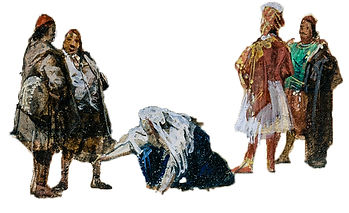
2b. Parts of Watercolour Figures from Paintings
Apart from the figures, I wanted the whole view look more artistic. The Collage Art (2c) inspired me and I decided to apply this art style into my works (3).

2c. The Collage Artwork, Violin and Pipe, 1913, Georges Braque

3a

3b

3c
For the background of two perspectives, I used an oil painting of Venice. Esmeralda is the city of water so I thought this The Giudecca (3c) perfectly fits the description of the city.


3d
3. Details of Perspectives 3a. Perspective 1 3b. Perspective 2 3c. Background of Perspectives, The Giudecca, 1854, David Roberts 3d. The Architectural Materials for the Texture of the Model of the Old Quad: Bluestone, Sandstone, and Plaster
To increase the reality of the perspective views, I used the common Western architectural materials (3d) for the texture of architectural elements.
Final Work and Analysis
Perspective 1 (4a) is about Marco Polo’s initial thoughts and feelings about the city of Esmeralda, one of the trading cities and the city of water. The complex network of canals and streets make the inhabitants’ choice between the land or the boat. Various transportation ways give the people of Esmeralda happiness. They would be excited about daily new routes. So when everything comes to Marco Polo’s eyes, he would be excited about these things. This kind of emotion is reflected in the colour of this perspective view 1. The first scene Marco Polo saw is the happy faces of ordinary people. Marco Polo sees the good face of the city.

4a

4b
4. Final Works of Perspectives 4a. Perspective 1 4b. Perspective 2
Through observation, Marco Polo becomes more aware of the city of Esmeralda and understands the sins hidden under the glamorous face. The second perspective view (4b) is still Marco Polo’s viewpoint. In this scene, Marco Polo obverses more citizens. As a trading city, there are also merchants in the city. They talk in this scene and reach a deal. In some dark corners, there are some illicit couples or thieves. The conspirators and the smugglers are also live in the dark of the city. So many complicated relationships and the noises make the second perspective’s environment become more tension but with some excitements. So I decided to use red colour in this scene.
Reflection
.jpg)
5. Final Work
In this project, it generally taught me how to transfer text to visual space by using digital techniques. It led me to create a city based on an invisible description. To be honest, in this project, I prefer to be an artist rather than an architect. I want to use the model and perspectives I created to express my understanding of Calvino's novel chapter. Therefore, I refer to many artworks, paintings about Venice to make the invisible city become visual.
Both the perspectives and the notations, however, are not very satisfying. My original idea about the perspectives is using the Collage art style. Because I am very good at using Photoshop, the final visual effort is not very eye-catching. For the notations, I should add some grey and dark grey marks on the blocks to show the hierarchy of Esmeralda. The whole model without those notations looks very flat and is not my ideal output. Therefore, I need to change them to reach my standard.
In short, this project gave me a chance to be an artist to create the visual city belongs to me.