Tianchen Xu
Reflective Journal

“Beloved architecture! In the end, its materials, its origins, its own relatively short life seems so human and touching that we are bound to consider it affectionately.”
Aldo Rossi
Formalised Timeline Diagram
identify the key aspects of each that were fundamental to my development as a designer
Tianchen Xu, 2021

Click to Zoom In
To Be the " Theorist"
Thematic Research
' You cannot not know history '
Philip Johnson
1.1 Response to Context & Learn from History
As globalisation deepens, the vast majority of modern cities look the same. None of the architecture seems to have taken root in the land. They are like embedded constructions within the Concrete forest that can be placed anywhere. Nowadays architecture either still follows Internationalism or some universal construction/aesthetic standards, or just is a fanciful folly manifesting a strong personal style. In short, none of them responds to the context in which they are erected.
In my design philosophy, architecture should be the mirror of the characteristics of the time and place where it stands. It should be rooted in the soil of the culture and history of its context and respond to the local geography, topography, and climate. In the Design Studio Delta, we were required to design a library within Chinatown. The Chinatown will define the role of important cultural architecture. I explored the heavy roof of traditional Chinese architecture and translated it to a modern language. In the meanwhile, the dome is an important architectural symbol of the spirit of the place of Melbourne. Thus, the Library was the symbolic representation of Chinatown, reflecting both Chinese and Melbourne cultures. (However, when talking about Chinese culture, it always is that of ancient China and traditional Chinese culture. It seems that the symbol or impression of modern/contemporary China disappears. Therefore, I tried to find a way to represent Chinese culture and identity today. )
Baracco + Wright Architects had a design of a pop-up garden for the site where the Library stands. Their design, in some ways, is trying to restore the historic urban landscape. However, whether these kinds of conservation of historical heritage can establish an emotional and memorial link with modern people and life is still a question.
At the Epsilon Design Studio, there have been a number of public housing projects within the target site. Our design proposal should be responded to the surroundings as well. Within Brunswick West, there are lots of traditional townhouses and terraces around the site. Thus, the design proposal should respect the environment and the existing conditions of the site. The design proposal, in some ways, is supposed to merge into the existing architectural culture and environment. In Darnika Czischke’s talk, the urban and typological implications should be considered for the future design project. Should we consider the co-housing project as a micro-city? Or an analogy of the hierarchy of the community/city? The architecture is a layered hierarchical structure in which each scale of decision-making and control embodies as some specific designated elements and components. Each of these architectural levels serves as the setting and context for lower levels to create and operate. From the large scale of the site area to the intimate scale of furnishings and objects inside a dwelling unit, all project levels take part in this hierarchy of architecture. The roles each level/element play within the architecture design and its hierarchical structure determines their functions and serving scope. Therefore, the co-housing project will be various depending on different environments and contexts. (See how these thoughts are reflected within the Urban Hamlet at Epsilon Studio Project section.)
The urban and typology of Chinatown is ambiguous. The typology of Chinatown is a mixture of modern architecture and old structures (e.g Victorian Terrace House, etc.). Thus, my design response in an area so steeped in history demands a respectful approach.


(From Left to Right) Parliament of Victoria, Supreme Court of Victoria, State Library of Victoria.

Abstraction of the Dome.

Chinese Roof and Platform.

Chinatown Library Proposal, Tianchen Xu, 2021.


PARK, Baracco + Wright Architects, 2019
Reflection Collage of PARK
' A House is a machine for living in.'
Le Corbusier
2.1 Architecture towards Future - Future Home
The core of residential housing is people or desires of people, and residential housing directly impacts people’s life.
We are entering a new design era, rapid population growth and high demands for housing globally, triggered a large-scale development of two contrasting housing typologies and urban forms. At Design Studio Gamma, I explored the novel typology of residential houses that respond to the architectural, ecological, and civic contexts. Adaptable dual occupancy dwellings will be one choice of future home. The adaptable dwellings allow the residents to make changes over time to meet different requirements while the dual occupancy allows people to accommodate and also active community engagement.


Living House Proposal, Carlton, Tianchen Xu, 2020.

Spatial Adaptation of Living House Proposal, Carlton, Tianchen Xu, 2020.

Living House Proposal, Carlton, Tianchen Xu, 2020.
Interior of Living House Proposal, Carlton, Tianchen Xu, 2020.
Verena von Beckerath designed a selection of housing projects, she and her partner explored how people live together. In their Wunschhaus#1, they explored different examples to describe the relationship between rooms and houses, rooms and corridors in their own language. They reserved the space of rooms and the space of corridor to define the quality of corridor within their design project. The large corridor space will enhance the interactions among family members. In addition, they presented some elegant hand drawings by Heinrich Tesserow to imagine the quality of rooms and space. Meanwhile, they designed a totally different corridor space in R50, a coliving residential project. In R50, they created all-around connected balconies without division, which give the residents chance to connect with not only the outdoor space but also the neighbours. The interior of R50 is a raw approach to the material, shifting from a nice and smooth surface to certain flexibility in the floor plan. Within the Urban Hamlet, the terrace of the terrace house around the site would be used as an archetypal form and be translated to the design proposal as 'vertical streets' for the residents, aiming to enhance communication and interaction. The idea of 'connected terrace as vertical streets' is, in some way, like the all-around connected balconies within Project R50 but having additional functions.

Corridor Space within Wunschhaus#1, Heide & von Beckerath.

Wunschhaus#1, Heide & von Beckerath.

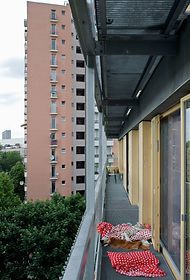


Details of R50, Heide & von Beckerath.


R50, Heide & von Beckerath.
Handdrawings, Heinrich Tessorow.

This lovely handdrawing displays a certain quality of
a room - large, cosy, poetic.
In Christina Gamboa’s lecture, the responses to community building and sustainability will be one direction of future homes. The adaptable dual occupancy dwellings for Studio Gamma is designed initially for multi-generation families over the decades. However, it could be also sharing housing for different household types. The spatial adaptability and dual occupancy are attractive to people who want to have interaction with other residents. While interacting with other people, independence and privacy are still maintained. One apartment/unit could be affordable for the young and the owner could be various. Pro-environmental features and designs will make the sharing housing more sustainably meet the future demands.
The future home should be able to change over time. Or the residential buildings should be constructed in an open building approach, which means it is flexible. In my case study Casa agli Orti, Buzzi Studio used the skeleton system with a vertical core to create the flexibility of the interior area. There is no load-bearing structure within the apartment, which give the residents the opportunity to make some changes. Like Till and Schneider discussed "Hard and Soft" in the article (2005), 'soft' refers to tactics that allow a certain indeterminacy and user to adapt the plan according to their needs. As the pandemic of COVID questioning the future relationship between working and living and in some ways changing the autonomies of two activities, Future Home is highly flexible for multiple unknown possible functions which living is the core. Thus, I believe "Hard and Soft" Pricincples/Technology will be one option to achieve the flexibility of the space.


Casa agli Orti, Buzzi studio d'architettura, 2016-19.

The Perspective of Casa agli Orti, Tianchen Xu, 2021.
Within the book Floorplan Manual Housing, Ried W2, the residential complex located in Niederwangen, Switzerland, is a simple and beautiful architecture project. The closed basic form of the complex, the flats facing the courtyard, the dense spatial atmosphere, making the Ried W2 have urban characteristics. The open staircases to the residential towers in the corners of the buildings and to the single-storey flats on the third floor are at the corners of the complex, making the circulation towards different unit typologies are clear and also leaving the open space in the centre of the complex.

Apartment + House & Spatial Adaptability Diagram of Case agli Orti,Tianchen Xu, 2021.

Ried W2, Switzerland.

Highlighted Overall Floor Plan of Ried W2 for Vertical Core and Corridor.
In Anna Puigjaner's Kitchen Stories, she discussed the culture of shared domestic spaces and collective kitchens. Different kitchen designs from different cultural backgrounds would be various and have individual features. For example, it is rare to see open kitchen designs within Chinese house and apartment designs due to the characters of the Chinese food and cooking method. Chinese families usually require the kitchen should be airtight to avoid the smell of cooking diffusing around the whole interior space. However, open kitchen plans are often seen within the architecture design from the non-Chinese background. The open kitchen makes the communication and interaction between the cook and the people more easily, connecting the dining space and merging into a larger open space within the home.

Chinese Kitchen scene.

Comedor Comunitario in Mexico City. Photo: Anna Puigjaner.


" The idea of home is ultimately a cultural construction whose malleable limits go beyond its physicality. " The kitchen, in some ways, replaces the chimney and hearth and then becomes the psychological and social centre of home nowadays.
In Anna's narrating, Mexico City initiated a city-backed collective lunch program, Comedor Comunitario, providing lunch for thousands of citizens in different communities. Comedor Comunitario transferred parts of the private home into the community kitchen, operating by the families and others who support the community. The community kitchen idea changed the dynamics of the neighbourhood and created the coexisting of the private and the public, the domestic and the urban, forming a collective urban system of the people for the people. The collective kitchen indeed addressed some social issues but it made private kitchens much more 'useless'. When becoming adults, people always miss the taste of their mother/grandmother's dishes during childhood. However, the fast and stressful nature of modern life also deprived people of the time to enjoy cooking at home. From my personal perspective, a private kitchen is still very important. The community kitchen could be replaced by other collective spaces. The point of the community kitchen is the "collective" instead of the "kitchen" itself. The collective space affects the neighbourhood and individual home, making the neighbourhood become a larger home. Therefore, I translated the similar idea of the collective kitchen into the vertical transport core within the Urban Hamlet project.
Anna's lecture reminds me of two famous kitchen-related designs and diagrams: The Frankfurt Kitchen and Increasing disorder in a dining table. The Frankfurt Kitchen was designed based on a purely functional approach to maximise the efficiency of workflow within the kitchen and to minimise repeated movements and space found in contemporary kitchens in the modern era, making the home cook's work easier.
Within Increasing disorder in a dining table diagram, Sarah and Jeremy analysed the movement of the people by the fundamental elements to make a better dining interface. The diagram also displays the interactions between occupants around the dining table and also in the home.
Frankfurt Kitchen Diagram and Image, Margarete (Grete) Schütte-Lihotzky.
In Beatriz Colomina's The Century of the Bed, Beatriz mentioned most young people work from bed. Behind the rapid economic growth is the sacrifice of sleep for the working class. The blur/change of autonomy of the bed is the result of the digital age when living and working are merging together to some degree. Therefore, the bedroom should be separated from the working space within the home, making the bedroom become the only peaceful realm for tired body and heart.
Although it is important to blur the hard boundary between different spaces within the home, most individual and private spaces still need respect and are maintained.

Increasing disorder in a dining table, Sarah Wigglesworth and Jeremy Till.
" What do you want, brick? "
" I like an arch."
" Look, I want one too, but arches are expensive and I can use a concrete lintel ... what do you think of that brick?"
" I like an arch."
Louis I. Kahn
3.1 Architecture, Structure, and Material Performance
The envelope of architecture is the skin, and materials and structure are the flesh and bones of the architecture. Thus, it is very important to understand material performance and the structure system.
From Construction as Alchemy to Construction Design, my understanding of materials and structure systems became more comprehensive and deeper. Materials are the flesh of architecture. Different materials have different properties and performances. Architects need to choose different materials according to building performance requirements (as well as aesthetics and budget). At the Construction Design, I developed a critical understanding of how to identify, evaluate and engage with the technological underpinnings of architecture. It is helpful for me to decide on different structural systems based on the spatial requirements. For example, the prefabrication elements are cost-efficiency and easy to construct. What is more, the choice of structure system and selection of materials is very important to provide the people with affordable architecture in the future to meet the high demands for housing.
In the meanwhile, I realised Building Information Modelling (BIM) is an indispensable element to the future of the Architecture, Engineering, and Construction (AEC) industry. It is very important for the AEC industry to make design, construction, and building performance better.


Digital Model of McKinnon Senior School, Tianchen Xu, 2021.

BIM Progress Work Image of Hotel Structure, Tianchen Xu, 2021

Foundation System of Hercules Hotel, Tianchen Xu, 2021
To block giant cruise ships, Stopper is located in the centre of the Giudecca Canal. Due to the soft and unstable soil conditions under the Lagoon, deep mixing soil techniques and a strong concrete base are essential for the construction of the tower. The deep concrete piles are driven into the deep layers of soil (beneath caranto), and the concrete platform is built on top of the piles. The concrete platform is 2 meters above the water levels of the Lagoon to protect the tower from surges and tides.
In order to make Hercules Hotel stands in the water stably, the 50cm concrete walls are applied for the basis of the hotel building. The upper part of the hotel is transparent, structured by the steel structure and covered by glasses, which makes the Hercules Hotel become the new lighthouse for the gondolas in Venice.
Within Modern Architecture: MoMo to PoMo (the history subject), I chose the Sidney Myer Music Bowl as the case study to learn how new construction materials and technologies shape the new method of architecture design in the post-war era.
The Sidney Myer Music Bowl is a bold, simple, and inventive Australian exemplar of the structural expressionism and materials experimentation of the 1950s. This project was a magnificent sound and architecture experiment at that time.
The structure of the Music Bowl is the language of cold calculation and simplicity, the machine aesthetic of the architecture. The structure of the bowl is full of curves, which breaks the stillness of the classic architecture and makes the structure dynamic. The large-scale wavelike sound shell appears to float in its open landscaped setting as if weightless. The canopy is a complex catenary structure that a supporting skin of aluminium-covered plywood panels was suspended between a web of pre-stressed steel cables The main cable was stretched between two tall cigar-shaped steel masts to support 27 cables with ends being buried deep in the ground on both sides. In the meanwhile, modern architecture materials such as steel and plywood allow the music bowl to obtain elasticity and lightness, which makes the form of architecture follows function. The wave-like sound shell is supported by acoustics inputs and give the audience maximum auditory enjoyment. The Sidney Myer Music Bowl holds a special place among 1950s intentional and Australian structural expressionism and shape buildings since it was ten years ahead of similar-styled projects in Europe.
The relationship of structure to landscape is organic and harmonious. The stage, orchestra pit and fixed seating are embedded within the ground below the canopy, which forms an amphitheatre with the sloping lawn. What’s more, there is no other decoration in the interior space, which is the essential character of modern architecture. The Sidney Myer Music Bowl is a functional and experimental epitome of modern Australian architecture - Boyd identified this project as the ‘climactic building of the period’.

The Sidney Myer Music Bowl.

The interior space of the Sidney Myer Music Bowl, Tianchen Xu, 2020.

The Sidney Myer Music Bowl, Tianchen Xu, 2020.
To Be the " Sythesis"
Epsilon Studio Project
Original Design Statement
Urban Hamlet is a micro-city where people find their own silent and peaceful dwellings for bodies and hearts, as well as establishing the bond with the neighbours and sharing resources.
Urban Hamlet is an interfaced, changeable, collective system of varied-sized unit typologies and a series of shared facilities and amenities, generating a self-organising network of individuals who are co-dependent on each other for mutual support in their living, working, producing, educating, and amusing.
As the pandemic of COVID questioning the future relationship between working and living and in some ways changing the autonomies of two activities, Urban Hamlet is highly flexible for multiple unknown possible functions which living is the core.
Therefore, the structure and material choice should be appropriate and affordable for flexibility and adaptation in both the short and long term.
Urban Hamlet will be the poetic follies for escaping from the noisy and busy city life.

Project Name and Logo, Tianchen Xu, 2021.
Revised Design Statement
Urban Hamlet is a micro-city where people find their own silent and peaceful dwellings for bodies and hearts, as well as establishing the bond with the neighbours and sharing resources.
Urban Hamlet is an interfaced, changeable, collective system of varied-sized unit typologies and a series of shared facilities and amenities, generating a self-organising network of individuals who are co-dependent on each other for mutual support in their living, working, producing, educating, and amusing.
Urban Hamlet draws on inspiration from the archetypal form of the Australian farmhouses including barns, huts, and chimneys, forming modest shelters that suggest a fantasy of the simple and cosy life.
The modest dwellings are the conjunction of antique and modern, the traditional materials and modern industrial products, transferring the old forms to something sensual for the present.
Urban Hamlet will be the poetic follies for escaping from the noisy and busy city life.
