Tianchen Xu
MODULE 3
Queen Victoria Garden Pavilion
In this module, we need to design a pavilion in the Queen Victoria Garden - location is the same as per the annual M-Pavilion. This pavilion should facilitate these activities: an evening quartet concert for an audience of 30 people and lunchtime seminar with 15 guests + 1 presenter. In the meanwhile, this pavilion should have a roof structure and can provide shade and shelter for people during the daytime.
Iteration Matrix of Pavilion

Iteration Matrix of Pavilion
In the beginning, I create an organic and curvy form to represent the form of the shells of snails. But this form is generated by the combination of two surfaces. The combination of two surfaces is not very workable for the next generation step. So I decided to abstract the shape of the shell and added some elements of Igloo.
The Kangaroo is the key within the whole parametric design. It is a digital engine for interactive simulation, form-finding, optimization and constraint solving. It can transform a two-dimensional surface into a tensioned three-dimensional surface. During the transformation, Kangaroo is always finding the best solver for the two-dimensional surface. I can control the parametric to adjust the height of the pavilion and the sizes of openings.
In the meanwhile, Lunchbox contributes to the early digital design as well. Lunchbox can explore mathematical shapes, panelling, structures, and workflow. I use Lunchbox to create panelling systems in hexagonal shapes, which is one of the foundational steps for the entire design.
NGon is also an important plug-in during my digital design. It can remesh my model evenly and allow me to work on every single face on the mesh. NGon helps me to generate the openings on the interior surface, to create the cellular structure based on the outline of each hexagon, and to form the complicated variant hexagonal shell for the pavilion.

Scripts of Pavilion Generation
Isometric Drawing of Pavilion

Isometric Drawing of Pavilion
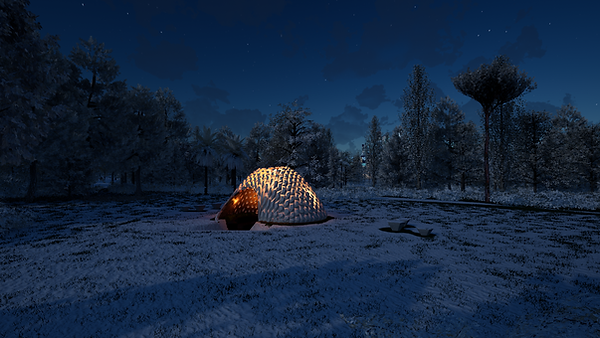
The process of my design starts from the shell of the snail with the inspiration of the Igloo. The whole pavilion is generated by digital method (i.e. Grasshopper) and can be controlled by the parametric to demonstrate my design thinking. The landscape or the terrain is also formed in the Rhino which should accommodate the design. The sunken interior space plays an important role in the whole design, and interior space cooperates with the dome-like pavilion to achieve my design goal -- providing a peaceful, silent, and contemplative space for the visitors in the busy city nowadays. The sunken interior space offers the audience a refreshing spatial experience as well as the feeling of isolated from the outside world. The interior space is the perfect place to sit, to think, to have a rest, or even to do the meditation.
The pavilion is a three levels structure: the smooth interior polysurface, the cellular structure, and the hexagonal shell. When entering the structure, the contrast between the smooth interior and the intricate exterior reveals a moment of surprise.
The internal surface of the pavilion is made of the oak, which is the interior decorated component to cover the supportive structure. The use of the oak for the interior surface cooperates the material of the indoor furniture, which can create a warm feeling.
The cellular structure of the honeycomb can support the exterior light concrete envelope of the pavilion. The cells stretch and orient themselves according to stresses.
The light concrete polysurface-envelope of the pavilion can resist the winds and outside environmental sounds, which offers the visitors a silent and peaceful space for the meditation.
The three structures work together to offering a peaceful space or spatial experience formed by light. The opening on the top of the pavilion can filter light into the interior space, which can make the interior space poetic and silent. Since the dramatic lighting comes into the interior space, space is presented by the ‘dark-light-dark’ rhythm.
Circulation & Threshold Diagram

Circulation Diagram
The circulation diagrams are demonstrating the human interaction with the pavilion
and the spaces it created. The bottom circulation diagram shows the audience’s
pathways towards the pavilion since there are two entrances of the pavilion. What’s
more, this diagram also pays attention to the relationship between time and density
which represents by different graphic figures and different values of the same colour.
The circle represents a group of people and the square represent the individual. And the
most popular space within the pavilion is the benches around the interior space. The
middle diagram shows the seating areas and the gathering areas within the pavilion
and the outdoor concrete stools. The pavilion structure shows the natural circulation of
the wind during the summertime and wintertime. The vertical arrow lines represent
the circulation of the sunshine pass through the opening on the top of the pavilion into the
interior space.

Threshold Diagram
Since this pavilion has designated entrance and exit, the audience is welcome to enter
into the pavilion by V-shape entrances. Before enjoying the peaceful interior central
area, the audience has to through openings on the shell. The concrete stair is a link
between the exterior space and the interior meditation area which is a relatively
private space. In the meanwhile, the audience would experience a strong contrast
between light and shadows. The top three diagram shows three main structures of
the pavilion. The interior surface with openings works together with the cellular structure
of honeycomb to put artificial lighting and brings bright into the interior space and give
the audience a strong suggestion of the pavilion in the night. The lightweight concrete
shell is also transparent and light. The openings of the shell work as the entrances of the
pavilion.
Textures & Materials

Lightweight Grey Concrete

Seasonal Oak Wood

Plywood

Wenge Wood
HEXAGONAL SHELL - CONCRETE
I would choose light grey concrete as the fabrication material for the shell. The concrete is waterproof and soundproof which is beneficial for the creation of a peaceful, silent, and rustic interior space. Concrete material is solid, which can offer the audience a feeling of isolation from the outside environment. In the meanwhile, the concrete I choose is lightweight which can be supported by the internal structure. What’s more, the concrete shell is thin and the light can pass through which would make the shell transparent and light. The concrete shell is unpolished so it is non-reflective.
CELLULAR STRUCTURE - PLYWOOD
The internal cellular structure of honeycomb can be constructed by the plywood. Cross graining in plywood helps to avoid the possibility to split while the edges are nailed. It helps to bind the grains more tightly. In the meantime, the plywood gives enriched spatial stability. The stiffness of plywood has made it hard to bend and inflexible. The plywood structure can be helpful to support the lightweight concrete shell.
INTERIOR - VARIOUS WOOD
The interior space of the pavilion can be created by various wood. For the interior ground and benches, I will choose the wenge, a dark-coloured wood. And I will choose the seasonal oak wood for the interior surface. The colour of the wood would give the audience inside a warm feeling and can help the visitors to do the meditation.
Render Image Gallery


Sectional Physical Model Image

Sectional Physical Model
For the physical model, in order to show as many details as all my design, I choose the half pavilion and the interior space to be modelled. The cooperation between the dome-like pavilion and the sunken interior space can give the audience the real physical spatial experience I want to have.
The sectional model cuts through the middle line of the pavilion and the site. This section model can clearly show how the dome-like pavilion works together with the sunken interior space to create a sense of peace and silent. For the pavilion, 3D printing will be the optimal fabrication method. The terrain, including the interior benches, would be created by the laser cutting.
Reflection
In this module, I learned the role of pavilions in contemporary design. So I was
asked for designing a pavilion within the Queen Victoria Garden. I tried to
understand the relationship between the pavilion and the site context. In the
meanwhile, I also looked at the ground and landscape as interfaces, which
can explore how the landscape and terrain shape my design.
The important section of this module is how to transfer the strategy to integrate
skills and strategies developed in M1 & M2 into M3. What’s more, the
core of this pavilion design is parametric. A variety of plugins were introduced
to us to expand our digital design strategies which can be used for
our pavilion design. The strategies that will be covered are only a very small
fraction of what is possible. Every tool has its use, so I explored for plugins that
are compatible in informing and developing our designs.